AI Technology
The AI Era: Surging Supply, Shrinking Purchasing Power
Follow Arun and Meera through an illustrated story about AI, livelihoods and purchasing power, with twelve chapters exploring who benefits when machines produce more.
Follow Arun and Meera through a changing world of work.
Indian English · AI narration · Continues from this spread to the end
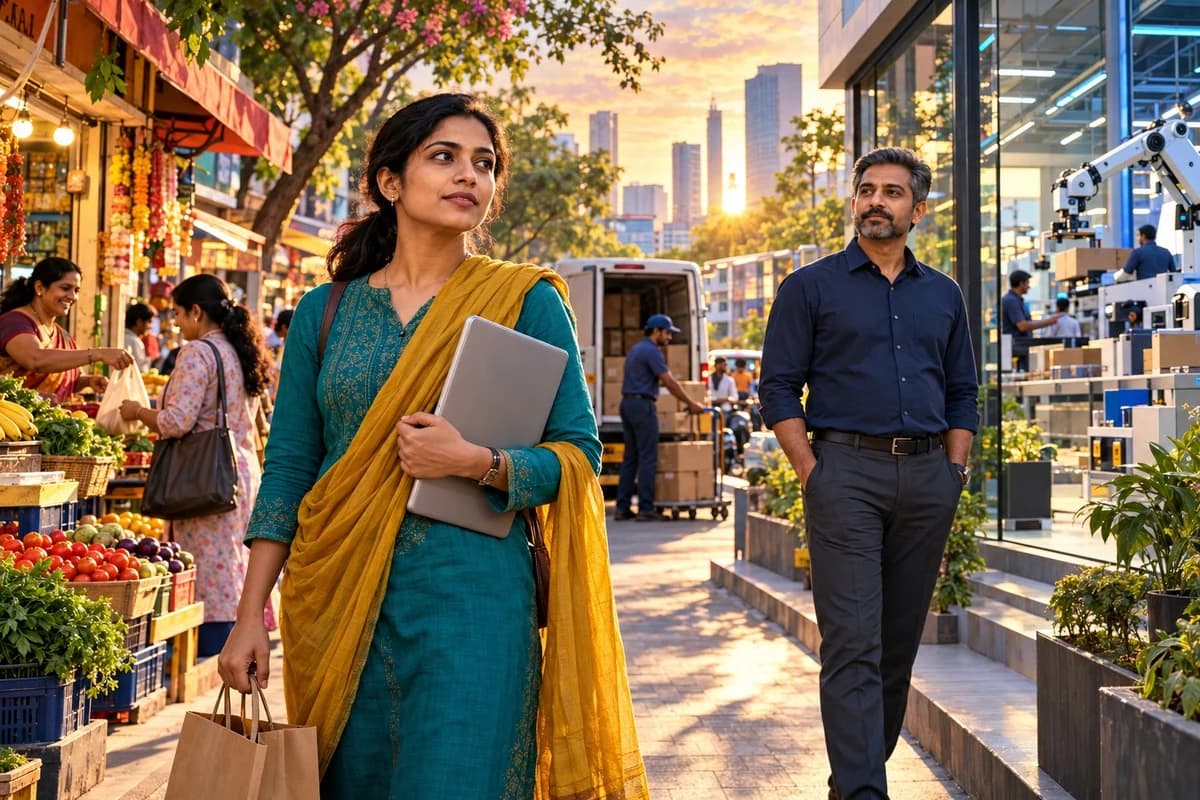 AI TECHNOLOGY · 01
Opening
The AI Era: Surging Supply, Shrinking Purchasing Power
When machines do more of the work, how will people earn a living?
A conversation about work, ownership and the right to a secure livelihood.
By Samprada Nagasubramanian. Illustrated edition, 21 October 2026.
Notes for this reading
Arun and Meera are fictional. Future scenarios are possibilities, not predictions. Research reviewed 6 October 2026.
Adapted from the supplied illustrated edition. Research references are preserved from the original article; scenarios are possibilities, not predictions.
Source guide from the original article
- 1. International Labour Organization (2025). Generative AI and Jobs A Refined Global Index of Occupational Exposure.
- 2. International Federation of Robotics (2025). Humanoid Robots Vision and Reality.
- 3. Alaska Department of Revenue. Permanent Fund Dividend About Us.
- 4. Norges Bank Investment Management. About the fund.
- 5. UCL Institute for Global Prosperity. Universal Basic Services.
- 6. IMF (2024). Fiscal Policy Can Help Broaden the Gains of AI to Humanity.
- 7. Bank of England. How is money created.
- 8. International Energy Agency (2026). Key Questions on Energy and AI.
- 9. Lee et al. (2025). The Impact of Generative AI on Critical Thinking. Microsoft Research and CHI.
Read the complete text without page turns
The AI Era: Surging Supply, Shrinking Purchasing Power
When machines do more of the work, how will people earn a living?
A conversation about work, ownership and the right to a secure livelihood.
By Samprada Nagasubramanian. Illustrated edition, 21 October 2026.
Arun and Meera are fictional. Future scenarios are possibilities, not predictions. Research reviewed 6 October 2026.
A salary disappears
Imagine a small company owned by Arun. Meera works there, answers customers' questions and earns a monthly salary. She uses that salary to pay her rent, buy groceries and send her child to school.
One day, Arun introduces an AI system. It answers many customer questions within seconds, works through the night and handles several conversations at once. After a period of testing, the company needs fewer people for that work. Meera loses her job.
Arun has reduced his costs. Meera has reduced her shopping.
Now imagine similar decisions happening across thousands of businesses. Companies can produce more with fewer people. But many of the people they have stopped paying were also somebody's customers.
Who will buy what the machines produce?
Arun and Meera are imaginary, but the question concerns every business owner and every household. If AI takes over a growing share of paid work, we will need ways for people to benefit from production even when they no longer earn a salary.
From the supplied illustrated edition by Samprada Nagasubramanian. The story and scenarios are illustrative.
Follow the paycheque
We usually think of an employee as someone who works for a company. Follow that employee's salary, however, and a much bigger picture appears.
Meera's grocery purchase helps the shopkeeper pay a supplier. Her rent contributes to her landlord's income. Her school fees help pay teachers. A restaurant she visits pays its cooks, vegetable vendor and electricity bill. Money passes through many hands, supporting different livelihoods along the way.
Business purchases have similar connections. A hotel buys laundry services. A laundry buys machines and detergent. Their suppliers have workers and expenses of their own. Whether we call these transactions B2C or B2B, there must be someone with a reason and the means to pay.
A company may save money by reducing its workforce. If many companies do it together, the lost salaries can affect businesses far beyond the companies making those decisions. The restaurant owner may never have replaced a cook with AI, yet still lose customers because nearby offices employ fewer people.
That is why the future of employment matters even to a business that feels well protected from automation.
From the supplied illustrated edition by Samprada Nagasubramanian. The story and scenarios are illustrative.
The new founder
AI can certainly bring benefits. It can reduce tedious work, help a small business serve customers and make some services more affordable. A lower price may attract customers who could not previously afford a product. Better tools may also create opportunities that did not exist before.
But a household has to look at its whole budget. Saving money on software does not compensate for losing the salary that paid the rent.
A cheaper product helps only if the customer can still afford it.
Meera decides to start her own business. She uses AI to create websites and promotional material for local shops. Her expenses are low because she does much of the work without hiring a team.
Then she discovers that many other people have had the same idea. Some offer similar services for less. Some shop owners use AI to do the work themselves.
Meera can create a website quickly. Finding someone willing to pay for it takes much longer.
From the supplied illustrated edition by Samprada Nagasubramanian. The story and scenarios are illustrative.
More sellers, fewer certainties
This could become a familiar difficulty in markets where AI makes similar products easy to create. More people can become sellers, but that does not automatically give their customers more money. Opening a digital storefront and earning a dependable livelihood are different achievements.
Some founders will succeed because they solve a real problem, reach the right customers or provide a service people trust. Others will close, change direction or join larger businesses. We should therefore avoid saying that nothing will sell. The concern is that a crowded market may provide secure incomes for far fewer people than the number trying to sell.
There is another detail worth watching. Meera pays for an AI subscription, cloud storage and advertising. She owns her small business, but other companies own much of the infrastructure she depends on. A world with many independent founders could still send a large share of its earnings to a few powerful providers.
From the supplied illustrated edition by Samprada Nagasubramanian. The story and scenarios are illustrative.
Will new jobs be enough
At this point, someone usually says, “Every new technology creates new jobs. People will adapt.”
That may happen in many areas. Current research does not show that all human employment is disappearing. The International Labour Organization expects many jobs affected by generative AI to change rather than vanish under the capabilities it assessed. [1]
Nevertheless, the reassurance leaves important questions unanswered. How many new jobs will appear? Can displaced workers learn them? Will they pay enough? And how long will they remain jobs for humans?
Suppose Meera retrains to manage AI systems. That could be a useful opportunity today. But if future AI systems can also manage other AI systems, she may face another round of disruption. A serious plan needs to consider that possibility alongside today's training needs.
Humanoid robots add a physical dimension. A robot could eventually undertake more tasks in factories, shops or homes. Looking human, however, does not make it capable of everything a person can do. Reliability, safety, price and maintenance will affect where robots are used. Nobody can confidently put a date on machines taking over almost all paid work. [2]
Still, we can ask what would happen if they did.
From the supplied illustrated edition by Samprada Nagasubramanian. The story and scenarios are illustrative.
A share of what machines produce
Suppose machines can produce food, construct buildings, move goods and deliver most services with very little human labour. There might be plenty to consume. The difficulty would be deciding how people obtain their share.
Today, most of us obtain that share mainly by working. We give our time and skills, receive money and exchange it for what we need. If paid human work becomes scarce, that route cannot serve everyone.
People would need a right to some of the output that machines produce.
One route is ownership. Imagine that Meera owns a small share of productive businesses through a citizen fund or a community enterprise. When those businesses earn money, some of the returns reach her. She receives income because she is a part-owner, even when she is not an employee.
Pensions and investment income already show that wages are not the only way people receive money. The challenge would be extending access to productive ownership to people who have little money to invest. Telling an unemployed person to buy shares does not solve that problem.
From the supplied illustrated edition by Samprada Nagasubramanian. The story and scenarios are illustrative.
Keeping a household afloat
Governments or communities could build funds that hold productive assets on people's behalf. Alaska's resident dividend and Norway's public investment fund offer partial examples of sharing the benefits of assets. They are not complete answers for a world without jobs, but they demonstrate that the principle is possible. [3, 4]
Another route is a dependable income floor. People whose earnings fall below a certain level receive financial support. A universal basic income would extend a payment to everyone within a defined population.
This could help Meera pay her bills and continue purchasing from businesses. But the payment needs a credible source of funding. Its amount must also bear some relationship to living costs. A small allowance is of little help if rent and food absorb several times that amount.
From the supplied illustrated edition by Samprada Nagasubramanian. The story and scenarios are illustrative.
Essentials without a salary
A third route is to reduce how much money people need for essentials. If basic healthcare, education, water, nutrition and transport are available without payment at the point of use, losing a salary would no longer threaten every part of family life at once.
Public services already work this way in limited forms. Extending them would require sufficient supply, good quality and fair access. A promise of free treatment means little if the clinic has no capacity to treat patients. [5]
These approaches could work together. Meera might receive basic services, some income support and a share of returns from collectively owned assets. She could still earn additional income from work where customers value her contribution. During a transition, shorter working hours could also help more people share the remaining work, provided the arrangement can protect their incomes.
The purpose would be to make a secure livelihood possible without requiring every person to win a permanent race against improving machines.
From the supplied illustrated edition by Samprada Nagasubramanian. The story and scenarios are illustrative.
Who pays for the transition
The government's position would change too. If fewer people earn salaries, taxes collected from salaries may fall. Governments would need to examine where income and wealth are going instead.
Profitable businesses, investment income, property and publicly owned assets could contribute to funding services and support. The IMF has proposed stronger protection and changes to taxation to spread AI's gains more widely. [6]
This does not mean that every automated company will be enormously profitable. Some will struggle because prices fall or customers disappear. Nor can a government promise unlimited payments from profits that have not yet materialised. Funding must allow for investment, maintenance and difficult years.
Printing money would not, by itself, solve the problem. More rupees do not create more homes or food. If spending rises faster than the supply of essentials, prices can rise too. Any income plan has to be connected to what the country can actually provide. [7]
Countries would also need to cooperate. A country that earns little from AI infrastructure cannot easily fund its people by taxing AI wealth located elsewhere. It may benefit from affordable technology, productive local investment and fairer arrangements for collecting taxes across borders. One wealthy country's solution would not automatically protect households everywhere.
From the supplied illustrated edition by Samprada Nagasubramanian. The story and scenarios are illustrative.
Could living become free
This brings us to an appealing possibility: could AI eventually make living free?
Picture an automated farm. Robots plant, monitor and harvest the crops. Human labour costs are much lower. Yet the farm still uses land, water, electricity, machinery and transport. Those resources have to be available, and worn-out equipment has to be replaced.
Similar limits apply to homes and healthcare. Faster construction does not create unlimited land in desirable locations. Better medical tools still require equipment and facilities. Even AI itself depends on physical infrastructure and electricity. [8]
So “free for life” can mean two different things. It could mean that everyone receives defined essentials without being charged when they use them. That is a possible direction for society, if production and funding support it.
It could also mean that every person can have unlimited quantities of anything they want. AI does not establish that possibility. When several people want the same scarce resource, society still needs a fair way to decide who receives it.
Money may therefore continue to exist even if salaries become less central. People could use it for extra space, travel, preferred services and other choices. The important change would be that access to basic living no longer depends entirely on having an employer.
From the supplied illustrated edition by Samprada Nagasubramanian. The story and scenarios are illustrative.
Keeping the human mind active
What about the fear that people will stop thinking?
Meera's child may grow up with AI as an everyday companion. It could explain difficult lessons, or it could simply provide answers that the child copies. Those uses have different consequences. A study of knowledge workers found that greater confidence in AI was associated with less reported critical-thinking effort; it did not prove that people inevitably become less intelligent. [9]
We would need to keep practising judgement. Children should still learn to read carefully, solve problems and explain their reasoning. Adults should still know how to make decisions and question automated advice. Convenience becomes a problem when we lose the ability to understand or challenge the systems we depend on.
Even so, a person who cannot earn as much as a machine is not useless. Raising a child, caring for a parent, creating art and participating in community life remain valuable. Much of that work already goes unpaid. A future with less compulsory paid work could give people more time for it, provided they have security and genuine choices.
From the supplied illustrated edition by Samprada Nagasubramanian. The story and scenarios are illustrative.
Two possible futures
For a business owner, the immediate lesson is to look beyond how quickly AI can produce something. Understand whose problem you are solving, who will pay and why they will keep paying. Use the savings to improve the offer where possible. An owner also has an interest in a society where customers retain purchasing power.
For households, learning to use AI may help today. It should be accompanied by independent skills, realistic financial planning and opportunities to share in productive assets. The responsibility cannot rest on individuals alone when the source of disruption affects the whole economy.
Return to Arun and Meera. In one possible future, Arun's company produces efficiently while Meera struggles to afford its products. In another, AI helps the company thrive and Meera receives enough benefit through work, ownership or public provision to live securely.
The machines could be equally capable in both futures. What differs is how people share the benefits.
An economy that can produce more should be able to help people live better. We need to make sure its way of distributing income can keep up with its way of producing wealth.
From the supplied illustrated edition by Samprada Nagasubramanian. The story and scenarios are illustrative.
Who benefits when machines produce more?
Production can rise. Human security should rise with it.
A conversation about work, ownership and the right to a secure livelihood.
Story images and diagrams are explanatory illustrations. Any resemblance to a real person is completely coincidental.
Arun and Meera are fictional. Future scenarios are possibilities, not predictions.
Research reviewed 6 October 2026 · Illustrated edition 21 October 2026. See the source guide below for the original references.