Technology • Python
Python Basics - Understanding Tuples in Python: The Immutable Sidekick
A tuple is an ordered, immutable collection of items. Once created, you can’t modify its contents—which makes it ideal for data that shouldn't change. This is how a tuple is created Unpacking a tuple View embedded…

A tuple is an ordered, immutable collection of items. Once created, you can’t modify its contents—which makes it ideal for data that shouldn't change.
This is how a tuple is created

Unpacking a tuple

Key Features
- Ordered: Elements maintain the order you assign.
- Immutable: Unlike lists, you can't alter, add, or remove items.
- Heterogeneous: Can hold different data types.
- Hashable: Useful as dictionary keys or in sets (if all elements are hashable).
When to Use Tuples
- To represent fixed collections, like RGB colors, coordinates, or database records.
- As function return values to return multiple items cleanly.
- When working with dictionaries as keys (since lists can't be keys).
Behind the Scenes
Tuples are lighter on memory and faster to access, making them perfect for performance-critical Python apps. Integrating tuples smartly can help you write cleaner and more efficient code.
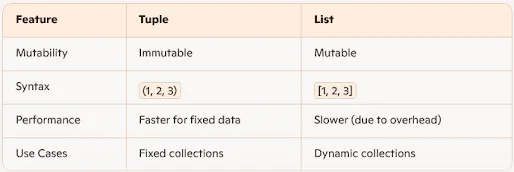
Comparison between the collection types : List Vs Tuples
Originally published on Inspire Innovative Learning.
View the original article