Bharat Paddhat
Pitru Paksha: A Journey of Remembrance
An illustrated journey through remembrance, time, offering, release and the living lineage. Open the book, turn the pages, and listen.
Turn a page. Stay with a thought.
Indian English · AI narration · Continues from this spread to the end
 BHARAT PADDHAT · 01
01 / Remembrance
Our lives did not begin with us
Someone kept a family together through hardship. Someone preserved a prayer, a recipe, a value, or a piece of knowledge. Their names may fade, yet the care they gave can still reach our table.
Pitru Paksha invites us to pause and recognise that inheritance. In many Bharatiya traditions, this waning lunar fortnight is a time to honour departed ancestors through shraddha, tarpana, and acts of care.
Water is offered. Food is prepared or shared. Names are spoken. Through these simple actions, gratitude takes a visible form. We remember the gifts we received, the responsibilities we carry, and the lessons we can choose to pass on.
Whose unseen effort made your ordinary life possible?
Speak one ancestor’s name. Ask an elder for a true story about that person, and record it with care.
Notes for this reading
Manusmriti 1.66; Shrimad Bhagavatam 5.26.5.
Adapted from the supplied Bharat Paddhat article. Sacred cosmology, research and personal reflection are presented as distinct kinds of knowledge. Practices vary by family and region.
Source guide from the original article
- Śrīmad Bhāgavatam 5.26.5 on Pitṛloka
- Manusmṛti 1.66 with Medhātithi commentary
- Manusmṛti 1.67 with Medhātithi commentary
- Manusmṛti 3.189 on ritual presence
- Viṣṇu Purāṇa 3.16 on śrāddha offerings
- Vāyu Purāṇa chapter 75
- Skanda Purāṇa 5.3.146
- Baudhāyana Dharmasūtra 2.8.14
- Garuḍa Purāṇa chapter 7
- Garuḍa Purāṇa chapter 16
- Bhagavad Gītā 1.42
- Sundeep Teki and colleagues on the internal clock
- Sundeep Teki and colleagues unified model of time perception
- B. N. Mallick and A. K. Mukhopadhyay on REM sleep and dream sleep
- B. N. Mallick and colleagues on REM sleep mechanisms
- Erlacher and Schredl 2004 lucid-dream timing experiment
- Norton and Gino 2014 on ritual grief and restored feelings of control
- Bose and colleagues 2026 Munger banyan radiocarbon study
- CDC family health history guidance
Read the complete text without page turns
Our lives did not begin with us
Someone kept a family together through hardship. Someone preserved a prayer, a recipe, a value, or a piece of knowledge. Their names may fade, yet the care they gave can still reach our table.
Pitru Paksha invites us to pause and recognise that inheritance. In many Bharatiya traditions, this waning lunar fortnight is a time to honour departed ancestors through shraddha, tarpana, and acts of care.
Water is offered. Food is prepared or shared. Names are spoken. Through these simple actions, gratitude takes a visible form. We remember the gifts we received, the responsibilities we carry, and the lessons we can choose to pass on.
Pause and reflect: Whose unseen effort made your ordinary life possible?
A simple practice: Speak one ancestor’s name. Ask an elder for a true story about that person, and record it with care.
Manusmriti 1.66; Shrimad Bhagavatam 5.26.5.
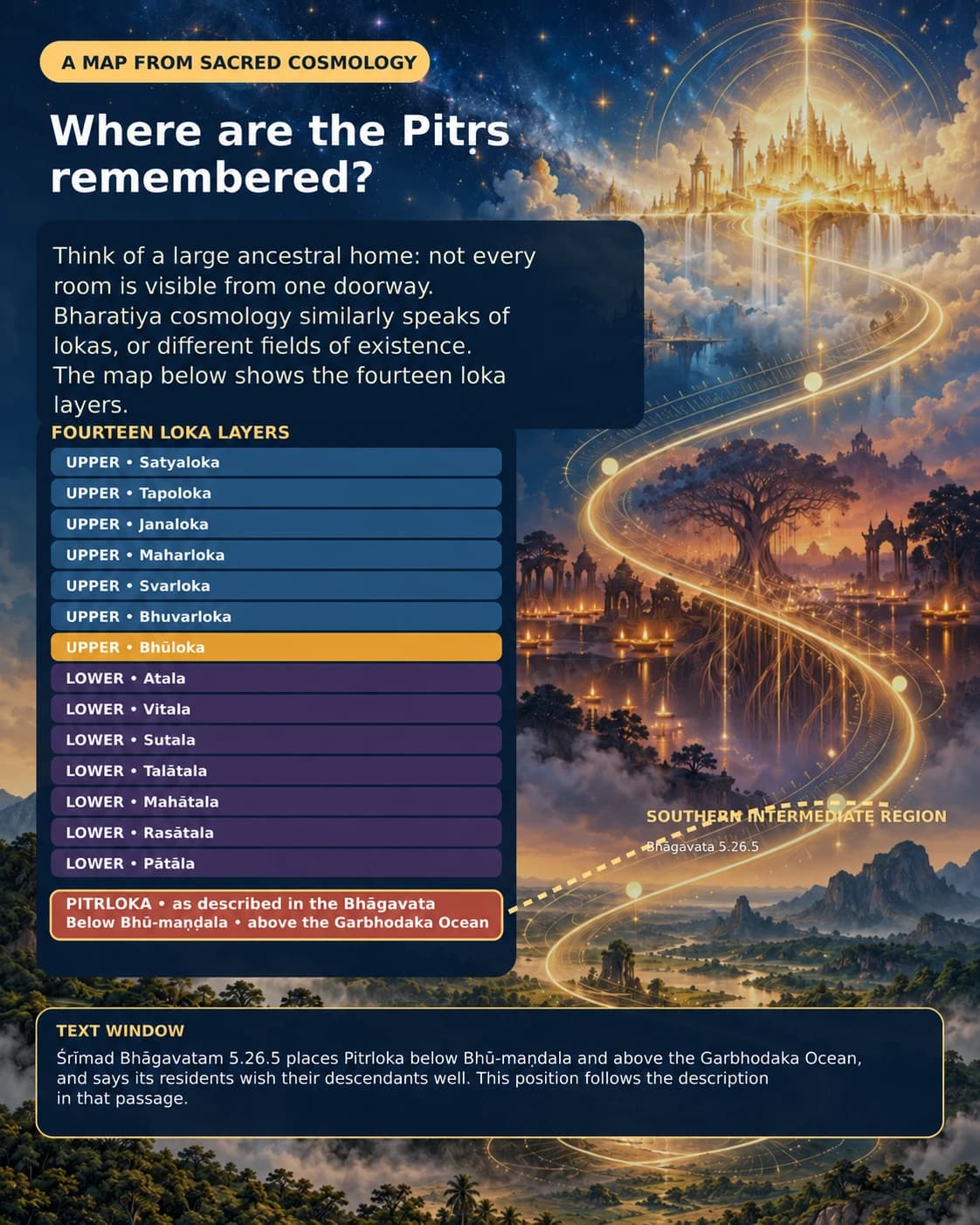
A relationship beyond the visible
Bharatiya texts speak of lokas, or realms of existence. Shrimad Bhagavatam describes Pitrloka and ancestors who wish their descendants well. This is a map of sacred cosmology: it expresses a relationship between the living family and those remembered beyond visible life.
The observance does not depend on knowing every name in a family tree. A prayer can include ancestors whose stories are lost, as well as those whose voices we still remember.
A paksha contains fifteen tithis, or lunar days. These do not always correspond to fifteen civil days. Families follow their local Panchanga and lineage customs when choosing the appropriate observance. The shared intention is remembrance, offered with sincerity.
Pause and reflect: What would you like the next generation to know about those who came before you?
A simple practice: Write down one name, one memory, and one quality you hope to carry forward.
Shrimad Bhagavatam 5.26.5. Family and regional practices vary.
Why the dates move
Why does Pitru Paksha fall on different dates each year? The answer begins with the calendar. The Panchanga follows the relationships of the Sun and Moon as observed from Earth. The Gregorian calendar follows the solar year. Their measures do not line up in exactly the same way each year.
There is another kind of time we recognise immediately. Five minutes of waiting can feel long; an hour with someone dear can pass quickly. The clock stays steady, while our experience changes.
Traditional texts use their own measures of time. Manusmriti describes a human month as a day and night for the Pitrs, and a human year as a day and night for the Devas. These are sacred teachings about time, not tested mechanisms of modern physics.
Pause and reflect: When has an hour felt short, and when have five minutes felt long?
A simple practice: Spend one quiet minute noticing the clock and your felt sense of time.
Manusmriti 1.66–1.67. Consult your local Panchanga for dates.
Dreams invite a question
A dream can seem to hold a long story inside a short sleep. That feeling makes a useful invitation to curiosity, but it does not tell us exactly how much time passed inside the dream.
Research on timing and sleep explores different parts of this question. Sundeep Teki and colleagues have studied how the brain constructs duration. B. N. Mallick’s work examines REM sleep and its relationship to dreaming.
In a small lucid-dream experiment, Daniel Erlacher and Michael Schredl found that counting took roughly as long in dreams as while awake, while squats took longer. The conclusion is modest: our experience of time can depend on the task and state. It does not establish the time scales described in sacred cosmology.
Pause and reflect: Can a question remain meaningful even when its answer is incomplete?
A simple practice: Notice one moment today when you become so absorbed that time seems to change.
Teki and colleagues on interval timing; Mallick and Mukhopadhyay on REM sleep; Erlacher and Schredl (2004), as cited in the supplied article.
A familiar recipe, a remembered voice
Cook a loved one’s recipe after they are gone, and the meal carries more than nourishment. A familiar aroma can bring back a voice, a gesture, or an afternoon spent together. Food becomes a tender language of remembrance.
Vishnu Purana describes an offering made with shraddha, while naming an ancestor and gotra, as nourishment suited to that ancestor. Within this sacred account, the offering reaches its recipient through the relationship and intention of the rite. It is not a description of eating through a physical body like ours.
Other texts use images of wind, aerial forms, and birds when describing ancestral presence. These passages help explain ritual associations. They do not mean that every bird we encounter is an ancestor.
Pause and reflect: Which food in your family carries a person’s memory?
A simple practice: Ask someone to share the story behind a family recipe, including the small details that make it theirs.
Vishnu Purana 3.16; Vayu Purana 75.13; Manusmriti 3.189; Baudhayana Dharmasutra 2.8.14.10; Skanda Purana 5.3.146.
Let memory become care
An offering can also do visible good here, among the living. A modest meal can become annadana: food shared with someone who needs it. Water can be offered thoughtfully. A recipe can be written down before its details disappear.
The value of the action does not depend on its scale. A carefully prepared portion, a name spoken with affection, or a meal shared without waste can give gratitude a practical expression.
In this way, remembrance reaches beyond a private feeling. It becomes hospitality, generosity, and attention. What we received from an earlier generation is carried forward through the care we offer now.
Pause and reflect: Who could receive care through the memory you cherish?
A simple practice: Prepare or share one simple item without waste. Remember the person who inspired it, and let the food serve someone living.
A reflective practice adapted from Reading Three of the supplied article.
Remembering without holding on
Grief can make love feel unfinished. We return to what was said, what remained unspoken, and what we wish we could repair. Pitru Paksha offers a place for those feelings within a prayer for peace.
The Garuda Purana treats desire and attachment as bonds within samsara, and describes compassionate rites that support release. This is a theological teaching. It should not become a claim that every departed person remains distressed or bound to the family.
A prayer can hold both the departed and the living. We wish our ancestors contentment and a peaceful onward journey according to our faith. We also allow ourselves to loosen guilt, resentment, and the fear that love will disappear if grief becomes lighter.
Pause and reflect: What would you say if love no longer needed to hold anyone back?
A simple practice: Pray in your own words: May you be content. May unfinished attachment be released. May your onward journey be peaceful.
Garuda Purana chapters 7 and 16, as cited in the supplied article.
A quiet gesture can be enough
The ritual does not demand a dramatic sign. A safely placed diya, a few quiet words, or a simple offering may express what the heart has carried for years.
Traditional practice gives fire, water, air, earth, and space a sacred role. We can honour that symbolism without presenting claims about elemental memory or the effects of mantras on water as established science.
There is no need to guess which ancestor may have left an unfinished wish. Remembrance can be generous enough to include them all. Nor must sorrow follow a timetable: if grief remains overwhelming, ritual can sit beside qualified mental-health support. Receiving care does not diminish devotion.
Pause and reflect: What small gesture would feel sincere to you today?
A simple practice: Choose a quiet, safe place. Offer a few words of gratitude, and allow yourself a moment of rest.
A reflective adaptation of Reading Four. Spiritual practice and professional care can coexist.
The banyan and the family
A banyan grows beyond a single trunk. Its branches send roots towards the earth. When those roots take hold, they become new supports, allowing the tree to spread its shelter.
Lineage offers a similar image. We stand because other lives became support beneath us. In time, our choices become roots for people we may never meet. Remembering ancestors is therefore also a question of responsibility: what kind of support will we become?
Some families describe renewed clarity after observing ancestral rites. Such experiences can be respected without promising a particular result. Research on rituals after loss has linked ritual with restored feelings of control. A steadier mind may help us recognise choices and take the next step.
Pause and reflect: What support did you receive, and what support can you become?
A simple practice: Record a family story with permission. Preserve the person’s own words wherever you can.
Norton and Gino (2014) on ritual after loss. The banyan is used here as an analogy for lineage.
What we choose to pass on
A truthful family record is an offering to the future. Names, stories, photographs shared with consent, and relevant health history can help those who come after us understand where they belong.
Families inherit more than memories. Genes, shared environments, and habits can influence health. Traditional discussions may use the term Pitru dosha, but it is not a medical diagnosis. Repeated illness deserves qualified assessment; family circumstances should not be treated as evidence of ancestral blame.
We cannot choose everything we inherit. We can choose how carefully we understand it, what kindness we preserve, and which harmful patterns we seek help to change. In that spirit, Pitru Paksha becomes both remembrance and care: gratitude for the roots, and responsibility for the shade yet to grow.
Pause and reflect: What would you like a future generation to receive from you?
A simple practice: Preserve one family story and one verified health-history fact, with respect for privacy. Share food with someone in need.
CDC family health history guidance, as cited in the supplied article. For lineage-specific rites, consult a qualified purohita.